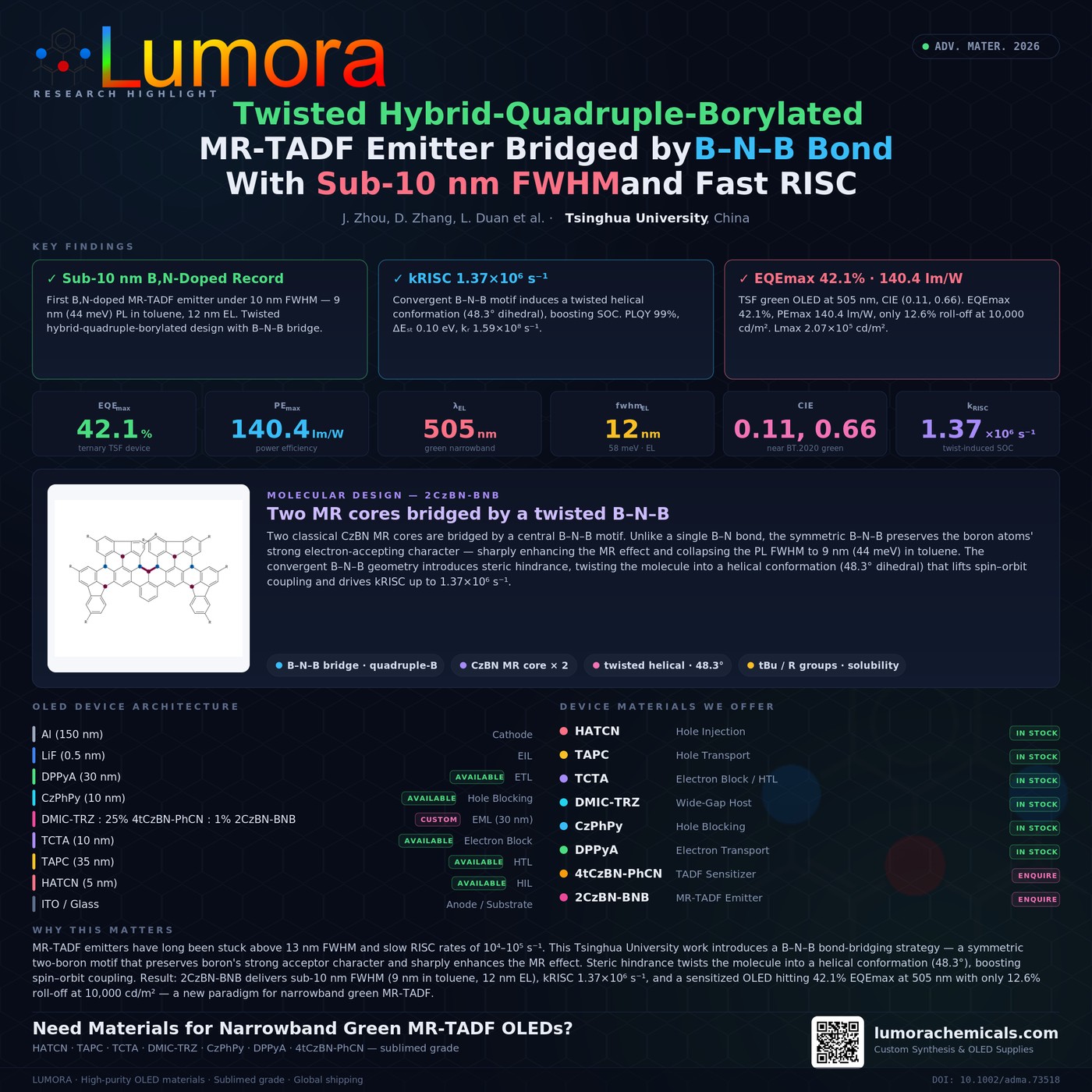
Why is it still difficult for MR-TADF OLEDs to achieve extremely narrow emission and fast triplet harvesting at the same time?
The core problem is that the structural features that make MR-TADF emitters spectrally sharp often slow down reverse intersystem crossing. Conventional B-N bonding can rigidify the framework and narrow emission, but it also weakens the electron-withdrawing character of boron and limits the multiple-resonance effect.
New work published in Advanced Materials by Zhou, Wang, Dai, Li, Zhang, Duan, Zhang, and co-workers shows that a B-N-B bond-bridged MR skeleton can overcome this trade-off by simultaneously strengthening atom-scale orbital separation and inducing a twisted geometry that accelerates RISC.
What they did
The authors designed a twisted hybrid-quadruple-borylated MR-TADF emitter, 2CzBN-BNB, by using a central B-N-B covalent bridge to connect two CzBN-type MR cores.
They combine:
A B-N-B bridge that preserves the strong electron-accepting ability of boron, localizes HOMO density mainly on nitrogen and LUMO density on boron, and enhances the multiple-resonance effect.
A convergent, sterically crowded molecular geometry that creates a twisted helical conformation, improving spin-orbit coupling without relying on heavy atoms.
A device-level strategy using both a binary emitter device and a ternary TADF-sensitized fluorescence architecture with DMIC-TRZ host and 4tCzBN-PhCN sensitizer.
The molecule was supported by DFT/SCS-CC2 calculations, single-crystal X-ray diffraction, steady-state and transient photophysics, and OLED device evaluation.
What they achieved
- Ultra-narrow green photoluminescence at 501 nm in toluene with an FWHM of only 9 nm (44 meV), and even 7 nm in n-hexane.
- Excellent TADF characteristics, including 99% PLQY in toluene, a 56% delayed component, a small experimental Delta EST of about 0.10 eV, and a fast kRISC of 1.37 x 10⁶ s-1.
- Green OLED emission at 505 nm with an EL FWHM of 12 nm. The binary device reached 31.5% EQE, while the ternary sensitized device reached 42.1% EQE and maintained 36.8% at 10,000 cd m-2.
Altogether, the work shows that B-N-B bridging can deliver MR-TADF emitters that are not only extremely narrowband but also fast enough for high-efficiency OLEDs with low efficiency roll-off.
What's worth taking from this
B-N-B motif actively changes the resonance electronic structure, orbital distribution, molecular twist, spin-orbit coupling, and device-level exciton utilization. By moving from simple B-N bonding or peripheral locking to B-N-B bridge engineering, the authors demonstrate that you can:
Push BN-doped MR-TADF bandwidth below 10 nm while keeping a strong radiative transition.
Accelerate RISC through molecular geometry and SOC control, rather than sacrificing color purity with heavy-atom effects.
Combine direct MR-TADF emission with sensitized triplet recycling to achieve high EQE and low roll-off at practical brightness.
For next-generation narrowband OLEDs, this paper reinforces the shift from peripheral substitution toward core-level MR skeleton engineering as a route to emitters that are simultaneously sharp, efficient, and device-practical.
Why is it still difficult for MR-TADF #OLEDs to achieve extremely narrow emission and fast triplet harvesting at the same time?
The core problem is that structural features enabling sharp emission often slow reverse intersystem crossing. Conventional B-N bonding rigidifies the framework and narrows emission, but weakens boron's electron-withdrawing character and limits the multiple-resonance effect.
New work in #Advanced_Materials by Prof. Duan, Zhang, and co-workers shows that a B-N-B bond-bridged MR skeleton can overcome this trade-off by strengthening orbital separation and inducing a twisted geometry that accelerates #RISC.
The authors designed a twisted hybrid-quadruple-borylated MR-TADF emitter, 2CzBN-BNB, using a central B-N-B bridge to connect two CzBN-type MR cores.
- A B-N-B bridge that preserves strong electron-accepting boron, localizes HOMO on nitrogen and LUMO on boron, and enhances the MR effect.
- A sterically crowded geometry creates a twisted conformation, improving spin-orbit coupling without heavy atoms.
- A device strategy using both a binary emitter and a ternary TADF-sensitized fluorescence system with DMIC-TRZ host and 4tCzBN-PhCN sensitizer.
- Ultra-narrow green photoluminescence at 501 nm with FWHM of 9 nm (44 meV), and 7 nm in n-hexane.
- Excellent TADF properties: 99% PLQY, 56% delayed component, Delta EST ~0.10 eV, and fast kRISC of 1.37 x 10⁶ s-1.
- Green OLED emission at 505 nm with EL FWHM of 12 nm. The binary device reached 31.5% EQE, while the ternary device reached 42.1% EQE and maintained 36.8% at 10,000 cd m-2.
Altogether, B-N-B bridging enables MR-TADF emitters that are both extremely narrowband and fast for high-efficiency OLEDs with low roll-off.
- B-N-B motif tunes resonance structure, orbital distribution, molecular twist, spin-orbit coupling, and exciton use. By moving from simple B-N bonding to B-N-B bridge engineering, the authors show you can:
- Push MR-TADF bandwidth below 10 nm while maintaining strong radiative transition.
- Accelerate RISC through geometry and SOC control without heavy atoms.
Combine MR-TADF emission with sensitized triplet recycling for high EQE and low roll-off.
- For next-generation narrowband OLEDs, this work reinforces the shift toward core MR skeleton engineering as a route to emitters that are sharp, efficient, and device-practical.
R&D and pilot quantities
We supply the key materials from this study in high-purity sublimed grades, from grams to kilograms, shipped worldwide.
Visit LUMORA →Kilogram to production, and custom MR-TADF
For large-scale supply, new emitter synthesis, and CRDMO support, work with LAMKO directly. Scope your project in the LUMI workspace, or send a partnership request.
Open LUMI workspace →Partner with us