Why is achieving highly efficient, stable, pure-green MR-TADF OLED emission still difficult even when narrowband emitters are available?
The core problem is that MR-TADF emitters can provide narrow color purity, but their long-lived triplet excitons and relatively slow RISC processes can still cause triplet-triplet annihilation and triplet-polaron annihilation at high brightness. Conventional single-host systems also struggle to simultaneously provide high triplet energy, balanced bipolar transport, smooth carrier injection, thermal stability, and a broad recombination zone.
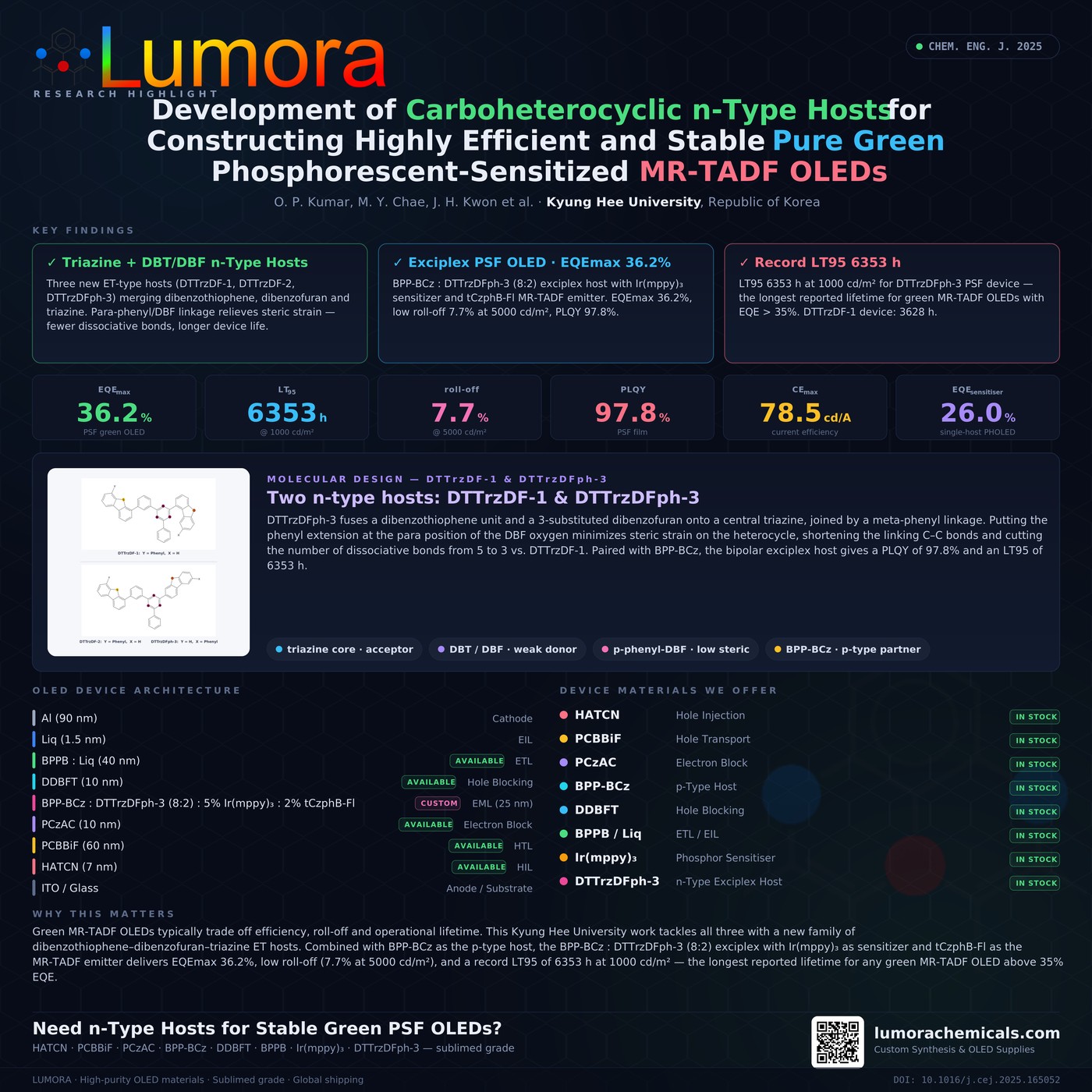
New work published in Chemical Engineering Journal by Kumar, Vergineya S, Muruganantham, Kim, Chae, and Kwon addresses this problem by developing carboheterocyclic n-type electron-transporting hosts for exciplex-based green phosphorescent-sensitized fluorescence OLEDs. The authors designed three triazine-based ET hosts, DTTrzDF-1, DTTrzDF-2, and DTTrzDFph-3, using dibenzothiophene and dibenzofuran units to control charge transport, bond dissociation stability, and energy transfer in pure-green MR-TADF OLEDs.
What they did
The authors built an exciplex host system by combining the newly synthesized n-type hosts with the p-type host BPP-BCz. Ir(mppy)3 was used as the phosphorescent sensitizer, while tCzphB-Fl was used as the pure-green MR-TADF final emitter.
They combine:
1. A triazine core that provides strong electron-transporting character and helps form the n-type component of the exciplex host.
2. Dibenzothiophene and dibenzofuran fragments that provide thermally stable carboheterocyclic frameworks and tune the HOMO/LUMO distribution.
3. Positional control of the dibenzofuran linkage, comparing DTTrzDF-1 and DTTrzDF-2, to understand how the attachment position affects photophysical properties, charge balance, and device behavior.
4. Phenyl-substitution relocation from the dibenzothiophene side to the dibenzofuran side in DTTrzDFph-3, which reduces vulnerable dissociative bonds and improves operational stability.
5. A PSF energy-transfer cascade in which the exciplex host transfers energy to Ir(mppy)3 and then to the MR-TADF emitter through FRET, enabling narrow pure-green emission from the final emitter rather than broad exciplex or phosphorescent emission.
The molecules were synthesized through Suzuki coupling, purified by vacuum-train sublimation, and evaluated using DFT/TD-DFT calculations, electrochemistry, TGA/DSC, UV-vis/PL/TRPL spectroscopy, BDE calculations, HOD/EOD charge-balance analysis, FRET calculations, PHOLED fabrication, and final PSF OLED device testing.
What they achieved
- The three ET hosts showed separated HOMO/LUMO distributions, supporting bipolar/exciplex-type transport behavior.
- All three hosts showed good thermal stability and chemical stability, with Tg/Td values of 120/443 °C for DTTrzDF-1, 114/485 °C for DTTrzDF-2, and 129/448 °C for DTTrzDFph-3, and high BDE values.
- In PSF films, DTTrzDFph-3 gave very strong photophysical performance, with PLQY of 97.8%, a higher RISC rate than the DTTrzDF-1 PSF film, and a high FRET efficiency of 82.1% from Ir(mppy)3 to tCzphB-Fl.
- The final pure-green PSF OLEDs achieved EQEmax values of 34.1% for BPP-BCz: DTTrzDF-1 and 36.2% for BPP-BCz: DTTrzDFph-3, with low roll-off of 4.1% and 7.7% at 5000 cd m-2, respectively.
- The optimized DTTrzDFph-3 PSF OLED showed pure-green EL at 535 nm with a narrow FWHM of 31 nm, CIE coordinates of (0.29, 0.68), and a current efficiency of 133.0 cd A-1.
- The operational lifetime was also outstanding: LT95 reached 217 h and 380 h at 5000 cd m-2 for DTTrzDF-1 and DTTrzDFph-3 PSF devices, corresponding to 3628 h and 6353 h at 1000 cd m-2 after acceleration-factor conversion.
Altogether, the work demonstrates that carefully engineered n-type exciplex hosts can improve charge balance, accelerate energy transfer, reduce unstable dissociative bonds, and deliver highly efficient and long-lifetime pure-green MR-TADF PSF OLEDs.
What's worth taking from this
The central message is that the final MR-TADF emitter is not the only material that determines device performance. In a PSF OLED, the exciplex host and phosphorescent sensitizer control where excitons form, how efficiently energy is transferred, how severe annihilation becomes, and how long the device survives under high brightness.
By moving from a conventional single-host approach to a structurally optimized exciplex host, the authors demonstrate that you can:
· Improve pure-green MR-TADF OLED efficiency while keeping narrow emission from the final emitter.
· Use an n-type host design to tune electron transport, exciplex formation, FRET efficiency, and operational stability.
· Increase device lifetime not only by improving PLQY or EQE, but also by reducing weak dissociative bonds through molecular design.
For next-generation green OLEDs, this paper reinforces exciplex-host engineering as a practical route to high-efficiency, low-roll-off, and long-lifetime narrowband MR-TADF display devices.
📄 DOI: 10.1016/j.cej.2025.165052
🔗 Paper: https://doi.org/10.1016/j.cej.2025.165052
R&D and pilot quantities
We supply the key materials from this study in high-purity sublimed grades, from grams to kilograms, shipped worldwide.
Visit LUMORA →Kilogram to production, and custom MR-TADF
For large-scale supply, new emitter synthesis, and CRDMO support, work with LAMKO directly. Scope your project in the LUMI workspace, or send a partnership request.
Open LUMI workspace →Partner with us